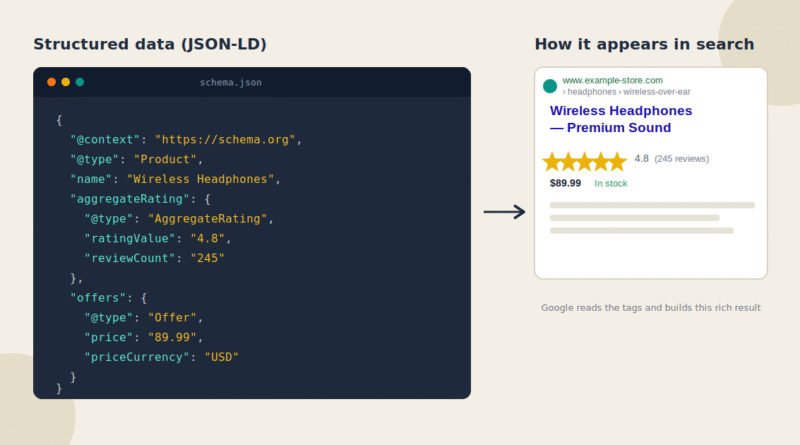
What Is Structured Data in SEO?
Structured data is a way of adding extra information to a web page so that search engines, especially Google, can understand exactly what that page is about.
When Google understands your content clearly, it can position that page more accurately in search results.
In simple terms: structured data helps search engines interpret your content, not just read it.
Google’s core job is to give users the most relevant, useful results possible. When your page includes structured data, Google can:
- Categorize your content correctly
- Match it with the right search queries
- Present it more effectively in search results
Structured data gives Google context that goes beyond the plain, visible text on your page.
Structured Data Is a Special Case in SEO
Most SEO work is built around the user, their needs, their experience, their search intent. Structured data works differently.
It’s one of the only SEO techniques designed specifically for search engines, not for the people reading your page. With structured data, you’re speaking directly to Google’s systems, essentially saying:
“Here is what this content represents.”
That’s what makes structured data such a unique and powerful tool in SEO. It’s less about persuading a human reader and more about handing a machine a clear, unambiguous label.
Breaking Down the Term “Structured Data”
The name explains itself once you split it in two:
- Data — the information on your web page (a product name, a recipe, a review score, an event date)
- Structured — organized into a format that search engines can understand
Structured data is written in a standardized format, so Google (and other platforms) can read, interpret, and use it efficiently — without having to guess.
How Does Google Uses Structured Data?
Structured data isn’t added to web content just for the sake of it. It is a standardized code format, built on the Schema.org vocabulary, that tells search engines directly what a page is about. Instead of working out the crux of a page by going through all the content on its own, Google gets clear, explicit signals.
With these signals, Google can better understand the content and, where a page is eligible, show it as a rich result. This is a more informative and attractive listing, with extra details displayed alongside the blue link.
Here are some of the ways Google uses structured data.
Star Ratings and Reviews
When we search for a product or service, we often see star ratings right under the blue link. This lets searchers see how well something is liked without clicking through. It is made possible by review structured data, which comes in two types:
- Aggregate rating: The average of many users’ ratings, shown as a star rating, usually with the number of reviews.
- Single review: One reviewer, such as a critic, an editor or a customer, reviews a product or service and gives it a rating.
Note: Google generally doesn’t show star ratings for self-serving reviews, where a business marks up reviews about itself on its own website.
Breadcrumbs
Breadcrumb structured data helps Google replace the plain URL in a search result with a trail such as Home › Blog › SEO. This shows where the page sits in the website’s hierarchy. Currently, this display appears on desktop results only.
Recipes
Recipe structured data has one of the most visible impacts in search results. Google can show key details, such as a photo, rating and cooking time, right in the results, helping searchers judge a recipe before clicking. If a site has a page listing several recipes and marks them up correctly, Google may also show them as a carousel.
Events
For concerts, ticketed events and conferences, structured data helps Google show the date, time, location and other details right below the blue link. Users can find what they need about an event without clicking through.
Local Business Details
When you search for a local business, Google can display its address, store hours and whether it is currently open or closed. Most of this comes from the Google Business Profile. Local business structured data on the website supports it by confirming the same details.
Knowledge Panel and the Knowledge Graph
For bigger brands and entities, Google picks up key information, such as the CEO, headquarters, images and stock information, from authoritative sources and shows it in a knowledge panel. All this information about entities, and how they relate to each other, is stored in the Knowledge Graph. Structured data on an official website helps Google connect the right information to the right entity.
What Structured Data Can’t Do
Structured data makes a page eligible for rich results, but it doesn’t guarantee them. Google decides whether to show a rich result based on the quality of the page, how well the markup matches the visible content, and Google’s own guidelines. It is also not a direct ranking factor. Its value lies in helping Google understand your content and making your listing more attractive to click.
Structured Data in Action: Rich Snippets
The easiest way to understand structured data is to see what it produces: rich snippets.
A standard search snippet usually includes just three things:
- Page title
- URL
- A short description
A rich snippet adds extra visual elements on top of that, such as:
- Star ratings
- Number of reviews
- Runtime, genre, or release date
- Product details and pricing
For example, a site like Rotten Tomatoes uses structured data to tell Google: “Here are the ratings, reviews, runtime, and genre for this film.” Google then uses that data to build a richer, more informative search listing.
Why Rich Snippets Matter
Listings with rich snippets:
- Stand out visually against plain results
- Attract more attention on the page
- Are more likely to get clicked
This typically leads to a higher click-through rate (CTR) compared to standard search snippets, which matters more than it might seem, as explained below.
Does Structured Data Affect Rankings?
Structured data does not directly help a page rank for more keywords. It’s not a ranking factor in the way that backlinks or page speed are.
However, it can still influence rankings indirectly by:
- Increasing click-through rates
- Improving user engagement with your listing
A higher CTR can improve rankings over time, because Google tends to favor results that users actually click on.
Better Understanding Leads to Broader Rankings
There’s a second, often overlooked benefit: content understanding.
When Google understands your page more precisely, two things can happen:
- Your page may start ranking for search terms you never explicitly optimized for
- Google can connect your content to related topics more accurately
Structured data gives search engines extra signals about what your page truly represents, helping it show up in places you didn’t specifically target.
Avoiding Structured Data Spam
It can be tempting to misuse structured data to game the system — for example, by:
- Adding schema for content that isn’t actually on the page
- Marking content inaccurately just to trigger rich snippets
This is risky. If you use structured data incorrectly or deceptively, Google may issue a manual penalty. Structured data should always describe what’s genuinely on the page, nothing more.
Structured Data Isn’t Just for Google
Google is the most common use case, but it’s far from the only one. Structured data is also read by:
- Other search engines
- Various other platforms that support structured data
These platforms can use the same markup to enhance how your content appears across the web, not just in Google search results.
Key Takeaways
- Structured data helps search engines interpret your content, not just read it.
- It’s one of the few SEO tools built for machines, not human visitors.
- It powers rich snippets, the star ratings, reviews, and extra details you see in search results.
- It doesn’t directly boost rankings, but it can improve CTR, which indirectly helps rankings.
- Better content understanding can help your page rank for terms you never targeted.
- Misusing structured data can lead to a manual penalty from Google, accuracy matters.
- It benefits more than just Google, including platforms like Facebook and Pinterest.