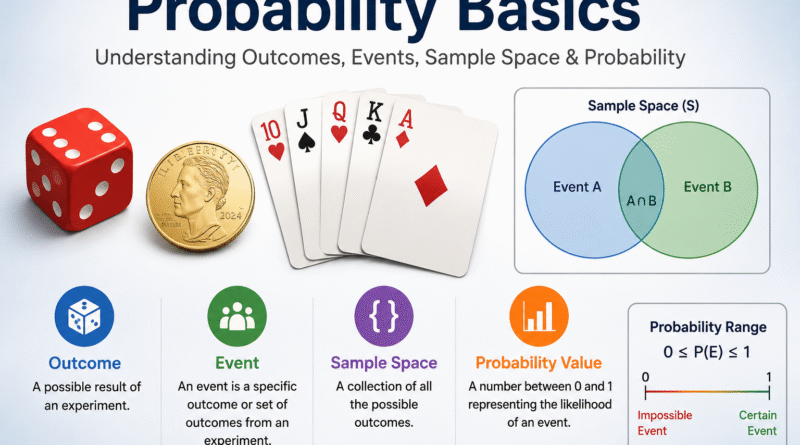
What is Probability in Data Science? Definition, Formula, Types and Example
Definition of Probability
Probability is the numerical measure of how likely an event is to occur. It ranges from 0 to 1, where 0 indicates an impossible event and 1 indicates a certain event.
Understanding Probability
Probability is a way of measuring uncertainty. It helps us estimate how likely an event is to occur when the outcome is not known in advance. Rather than predicting the future with uncertainty, probability provides a numerical measure of the likelihood of different outcomes.
For example, the probability of the rain tomorrow is 80% then it is not certain that it will rain. It indicates that there is a higher chance of rain based on available data and forecasting models.
The Probability Scale
Probability is always expressed as the value between 0 and 1.
| Probability Value | Meaning |
| 0 | Impossible event |
| 0.1 | Very unlikely event |
| 0.5 | Equally likely to occur or not occur |
| 0.9 | Highly likely event |
| 1 | Certain Event |
Probabilities can also be expressed as percentages. For example:
0.25 = 25%
0.50 = 50%
0.75 = 75%
1.00 = 100%
Why is probability important?
In real life, we often have to make decisions without knowing exactly what will happen in the future. Probability helps us measure uncertainty and estimate the likelihood of different outcomes. This allows individuals, businesses, and organizations to make more informed decisions instead of relying purely on guesswork.
By understanding the probability of an event occurring, people can better plan for the future, assess risks, and make predictions based on available information.
What are the Types of Probability?
Probability is always used to predict the chance of an event occurring but that prediction is done based on the information that we have.
The way we will predict our chances in a coin flip will be very different from how a meteorologist would go about predicting the weather or an investor would look at the trends in a volatile stock market.
As uncertainties could come in various forms, so mathematicians and statisticians have classified the probability into different types.
Some types use math formulas; others use real word experiments and some use expert guesswork.
Each one of these types turn uncertainty into clear numbers.
Theoretical Probability: The “In a Perfect World” Math
Theoretical probability is what would happen in a perfect world based on pure math, before you actually try it out.
You do not need to conduct an experiment like flip a coin or spin a wheel to find the answer. Instead, you just count the total possible outcomes and see how many of those give you the result you want.
It assumes that every single outcome has an exact, equal chance of happening, with no outside interference like a blast of air, a bad nice or somebody cheating.
How to Calculate It (The Simple Recipe)
To find the theoretical probability, you create a simple fraction:
A Simple Everyday Example
Imagine you have a bag containing 5 marbles: 3 are blue and 2 are red.
If you close your eyes and reach in, what is the chance of grabbing a red marble?
The theoretical probability is 2 out of 5 (or 40%).ability = The number of ways you can win / The total number of things that could happen
The number of ways to “win” (get a red marble) is 2.
The total number of things that could happen is 5.
The theoretical probability is 2 out of 5 (or 40%).
Experimental Probability: The “Real-World Trial” Math
Unlike theoretical probability, which looks at ideally what should happen on paper, experimental probability is entirely based what actually happens in real life.
To find it, you do not actually look at the options available. You actively run a test, conduct an experiment or look at past data to see the real-world results
How to calculate it?
To find experimental probability, you create a fraction based on your actual test results
Probability – Number of times your event actually happened / The total number of times you tried it
The Coin Toss Example
Imagine you have a standard coin.
1. The Theoretical Side (On Paper):
Before you even flip it, you know a coin has 2 sides (Heads and Tails). The math on paper says your chance of getting Heads is exactly 1 out of 2 (50%). [1, 2, 3, 4]
2. The Experimental Side (In Real Life):
Now, you actually sit down and flip that coin 10 times in a row. Because the real world is a bit random, you don’t get a perfect split. You end up landing on Heads 4 times and Tails 6 tBased on your real-world test, the experimental probability of getting Heads is 4 out of 10 (40%).Simple Examples of Probability in Everyday Life
Subjective Probability: The “Expert Guess” Math
Unlike the first two types, subjective probability does not rely on math equations on paper or real-world experiments. Instead, it is based entirely on personal judgment, feelings, intuition, and experience. [1, 2, 3, 4, 5]
It is a calculated guess about the likelihood of a unique event happening, usually where no hard data exists. Because it is subjective, two different people looking at the exact same situation can come up with completely different percentages. [1, 2]
A Simple Everyday Example
Imagine it is Sunday evening, and you are trying to decide whether to bring an umbrella to work tomorrow. You look out the window and see a few dark clouds.
- You look at the sky and say: “I feel like there is an 80% chance it will rain tomorrow.”
- Your friend looks at the same sky and says: “I think those clouds will blow over. I say there is only a 30% chance of rain.”
Neither of you used a calculator or counted historical rain data. You both just used your personal intuition and past experience to assign a percentage to an uncertain future event. [1, 2, 3]
Why We Need It
In a perfect world, we would always use pure math formulas. But in real life, many situations are completely unique and cannot be tested in a lab.
Subjective probability is incredibly useful for:
- Business owners: Estimating the chances that a new product will be a massive hit.
- Sports fans: Guessing the probability of their favorite team winning the championship this year.
- Investors: Predicting whether a new startup company will succeed or fail. [1, 2, 3, 4, 5]
It turns personal human expertise into a number we can use to make decisions.
Probability in Data Science and Artificial Intelligence
Probability forms the foundation of modern data science and artificial intelligence.
Machine learning models use probability to:
- Classify emails as spam or non-spam
- Predict customer behavior
- Detect fraudulent transactions
- Recommend products and movies
- Forecast business trends
- Analyze medical data
Many AI systems do not make absolute decisions. Instead, they calculate probabilities and select the most likely outcome.
For example, an AI model might determine that an image has:
- 95% probability of being a cat
- 4% probability of being a dog
- 1% probability of being another animal
The model then predicts the image contains a cat because it has the highest probability.
Weather Forecasting
Weather is one of the best examples of uncertainty in everyday life. Even with advanced technology, meteorologists cannot predict future weather with complete certainty because weather conditions are influenced by many changing factors such as temperature, air pressure, humidity, and wind patterns.
Probability helps meteorologists estimate how likely certain weather events are to occur based on data collected from weather stations, satellites, radar systems, and computer forecasting models.
For example, if a weather forecast reports an 80% chance of rain tomorrow, it does not mean that it will definitely rain. Instead, it means that based on the available data and weather models, rain is considered highly likely.
People can use this probability to make practical decisions. For instance, they may decide to:
- Carry an umbrella when leaving home.
- Postpone outdoor events such as picnics or sports activities.
- Plan travel routes that are less affected by bad weather.
- Take precautions to protect crops, equipment, or property.
A Simple Example
Imagine two different forecasts:
- 20% chance of rain: Rain is possible, but not very likely.
- 80% chance of rain: Rain is much more likely, so it may be wise to prepare for wet weather.
In both cases, probability does not guarantee the outcome. It simply helps people understand the level of risk and make better decisions.
Why Probability Matters in Weather Forecasting
Without probability, weather forecasts would only provide vague statements such as “it may rain” or “it may not rain.” Probability gives a numerical measure of confidence, making forecasts much more useful.
For example:
| Forecast | What It Means |
|---|---|
| 10% chance of rain | Rain is very unlikely |
| 50% chance of rain | Rain and no rain are equally likely |
| 90% chance of rain | Rain is highly likely |
How Probability Improves Decision-Making
Businesses and organizations also rely on weather probabilities. Airlines use weather forecasts to plan flight schedules, farmers use them to decide when to plant or harvest crops, and event organizers use them to determine whether outdoor events should proceed.
By estimating the likelihood of future weather conditions, probability helps individuals and organizations reduce risk, prepare for possible outcomes, and make more informed decisions.
In this way, probability transforms weather forecasting from simple guesswork into a scientific process based on data, analysis, and statistical models.
Medical Diagnosis
Doctors often need to make decisions even when they do not have complete information about a patient’s condition. Symptoms such as fever, cough, headache, or fatigue can be caused by many different illnesses. Probability helps doctors estimate which condition is most likely based on the available evidence.
For example, imagine a patient visits a doctor with a fever, cough, and sore throat. These symptoms could be caused by a common cold, the flu, COVID-19, or another respiratory infection. Instead of guessing, the doctor considers factors such as the patient’s symptoms, medical history, physical examination, and test results to determine which illness is most likely.
If a test result indicates a high probability of a particular disease, the doctor may recommend further testing or begin treatment. As more information becomes available, the estimated probabilities can change, helping the doctor make more accurate decisions.
Probability is also used when evaluating medical tests. No medical test is 100% accurate. A test may sometimes incorrectly indicate that a disease is present or absent. By understanding the probability of different outcomes, doctors can better interpret test results and decide on the most appropriate course of action.
In this way, probability helps healthcare professionals:
- Evaluate symptoms and test results
- Estimate the likelihood of different diseases
- Choose appropriate treatments
- Assess risks and possible complications
- Make informed medical decisions under uncertainty
Without probability, medical diagnosis would rely much more on guesswork. Probability provides a scientific way to analyze evidence and improve the accuracy of healthcare decisions.