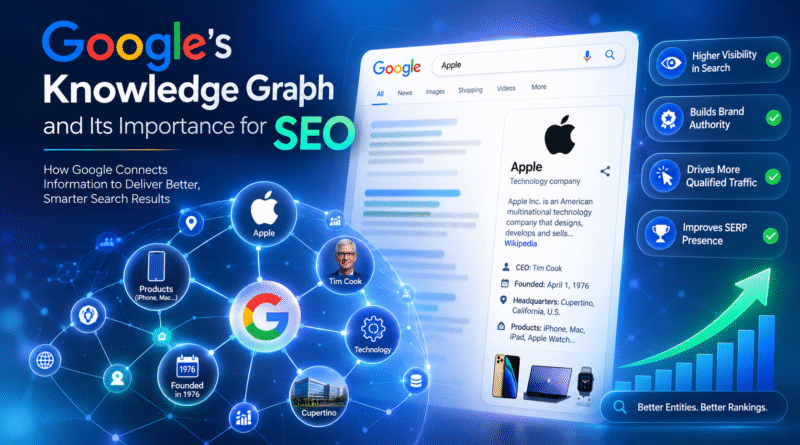
What Is Google’s Knowledge Graph? (And Why Every SEO Should Care)
If you’ve ever searched for a famous person, a landmark, or a big brand and noticed a box of information pop up on the right side of the results — with photos, a summary, quick facts, and links — you’ve met Google’s Knowledge Graph.
Most people scroll right past it. But if you’re doing SEO, this box is one of the clearest windows into how Google actually “thinks” about the web. Understanding it changes how you approach structured data, content, and even how you think about your own brand online.
Let’s break it down in plain English.
The Big Idea: Google Doesn’t Just Match Words Anymore
Old-school search engines worked like a filing cabinet of keywords. You typed “Eiffel Tower,” and Google found pages containing those words.
Modern Google works differently. It tries to understand that “Eiffel Tower” isn’t just a string of text — it’s a thing. A real, specific object in the world, with a location, a height, an architect, and a Wikipedia page. Google calls these things entities.
An entity can be:
- A person (Elvis Presley)
- A place (the Tower of London)
- A company (Nike)
- A creative work (a movie, a book, a video game)
- Pretty much anything specific and identifiable
The Knowledge Graph is Google’s giant database connecting all of these entities together — who they are, what they relate to, and what’s true about them. It’s less a keyword index and more a map of things and how they connect.
What a Knowledge Panel Actually Shows You
Search “Tower of London” and Google doesn’t just show blue links — it builds a rich panel with photos, a map, opening hours, a short history, popular visiting times, and a “people also search for” section.
Search “Elvis Presley” and you get a biography, birth and death details, famous songs you can click through, and quotes.
Search “Tomb Raider” and Google somehow understands that this is simultaneously a video game franchise and a movie — showing you the game’s characters and developers alongside the 2018 film adaptation.
None of that comes from one single webpage. It’s assembled from many trusted sources and stitched together because Google has already decided these are significant, well-established entities worth understanding deeply.
Why Two People With the Same Name Get Treated Differently
Here’s a detail that reveals a lot about how this works: search a name shared by a celebrity and an ordinary person, and only the celebrity gets a Knowledge Panel.
This isn’t Google being biased — it’s Google requiring proof of significance. An entity earns a spot in the Knowledge Graph by being referenced consistently, across multiple credible sources, over time. A regular person simply hasn’t accumulated that web of verified, corroborating information yet (which, honestly, is a privacy feature as much as a limitation).
Where Wikipedia Fits In
You’ll notice Wikipedia shows up constantly as the source of Knowledge Panel descriptions. That’s not a coincidence. Wikipedia is:
- Heavily fact-checked and cited
- Structured in a predictable, machine-readable way
- Continuously updated by a large community
Google treats it as a high-authority reference point precisely because it’s easy to verify and cross-check against other sources. This is a good mental model for SEO in general: the sources Google trusts most are the ones that are consistent, well-corroborated, and easy to verify — not necessarily the ones that shout the loudest.
Here’s the Part Most SEO Guides Skip: Structured Data Alone Won’t Get You a Knowledge Panel
This trips a lot of people up. You add schema markup (structured data) to your site, and you might assume a Knowledge Panel for your business or your personal brand is right around the corner.
It isn’t — and understanding why is more useful than the disappointment of finding out the hard way.
The Knowledge Graph isn’t built from a single site’s structured data. It’s built by cross-referencing many authoritative sources about the same entity. Structured data is one input among many — a way of clearly labeling “this is a Person,” “this is a Product,” “this is a LocalBusiness” — but Google still checks that label against everything else it knows before it trusts it enough to feature in a panel.
Think of it like a background check. You filling out a form saying “I am a licensed professional” is useful information — but it only becomes trusted once it’s corroborated by other records, references, and independent sources.
So What Does Structured Data Actually Do, Then?
If it doesn’t guarantee a Knowledge Panel, why bother with it? Because its real job is different — and arguably more useful day-to-day:
1. It removes ambiguity. Without structured data, Google has to guess what a page is about using context clues. With it, you’re explicitly telling Google: “this number is a price,” “this list of people are the authors,” “this date is the event start time.” Less guessing means fewer mistakes in how your content gets understood and displayed.
2. It’s the language Google uses for rich results. Star ratings, recipe cards, FAQ dropdowns, product prices, event dates in search results — nearly all of these “rich results” require structured data. They don’t build a Knowledge Panel, but they do make your listing bigger, more clickable, and more trustworthy-looking than a plain blue link.
3. It feeds entity understanding over time. Even if one page of structured data won’t create an entity, consistent structured data across your site — paired with consistent information about you or your business elsewhere on the web (social profiles, directories, press mentions, Wikipedia if applicable) — is exactly the kind of corroborating signal that does eventually contribute to entity recognition.
The Practical Takeaway for SEO: Think Like an Entity, Not Just a Keyword
Here’s the mindset shift that actually matters: stop asking “what keywords should this page target?” as the only question, and start also asking “what entity does this page represent, and is that entity clearly and consistently described everywhere it appears online?”
In practice, this means:
- Be consistent. Your business name, address, and details should match exactly across your website, Google Business Profile, social media, and directories. Inconsistency is exactly the kind of thing that stops Google from confidently connecting the dots.
- Get referenced elsewhere. A single well-optimized page rarely builds entity trust alone. Mentions, citations, and links from other credible sites are what corroborate that you (or your business) are a real, significant entity.
- Use structured data as a clarity tool, not a magic trick. Mark up what’s genuinely true about your content — don’t treat schema as a hack to fake authority you don’t have.
- Study existing Knowledge Panels in your niche. Before writing structured data for your own entity, look at how Google already represents similar people, places, or businesses. It shows you what Google considers the defining facts for that type of entity — which is a strong hint at what it’s looking for from you too.
The Bottom Line
The Knowledge Graph isn’t a feature you optimize for directly — it’s the result of doing entity-based SEO well over time. Structured data helps Google understand you correctly, consistency across the web helps Google trust what it finds, and authority (built the slow way, through real mentions and credible sources) is what eventually earns you a seat at the table.
It won’t happen from one schema tag on one page. But understanding how the pieces fit together is what separates SEO that just chases keywords from SEO that builds something Google — and people — actually recognize as legitimate.